
As the cost crisis continues and energy bills remain a concern, SPICe has received an increasing number of enquiries and visits to our blog from 2019 on wood burning stoves and air quality. People are interested in exploring alternative energy options and whether they can heat their homes in a more affordable way. This blog is an update to our previous post, with additional information to help you understand recent legislation around wood burning stoves and how it may apply to you.
Can I still use my wood burning stove in Scotland?
In January 2022, new European regulations came into force to ensure that all new wood burning stoves, multi-fuel stoves and fireplaces that are manufactured must meet strict new guidelines known as Eco-design.
“Eco-design considers environmental aspects at all stages of the product development process, striving for products which make the lowest possible environmental impact throughout the product life cycle.”
definition by European Environmental Agency
These new rules outlawed the sale of the most polluting fuels and guarantee that only the cleanest stoves have been available from 2022. The new rules only cover solid fuel burning room heater appliances placed on the market since 1 January 2022. The Eco-design legislation forms part of retained EU law and will therefore continue to have effect after the UK’s exit from the EU.
If you own a wood burning stove which was installed before January 2022, you do not have to do anything about it, even if it does not meet these new standards, as the legislation does not relate to appliances installed prior to January 2022. With that said, if the appliance is more than 10 years old, it could be worth looking into replacing it with a more efficient and cleaner burning one. Newer models need to use less fuel to provide the same energy output, which means that they produce fewer emissions and cost you less money. If you live in a smoke control area, there are other factors to consider; please see “what is the role of local authorities” for more on smoke control areas.
What about this New Build Heat Standard?
On 01 April 2024, the New Build Heat Standard (NBHS) regulations came into effect in Scotland. These standards affect what type of heating systems can be used in new build homes and properties. There has been some confusion around what the implementation of these regulations means for those who already have wood-burning stoves, so this blog has been updated to provide some clarity on this.
What is the NBHS?
NBHS is part of the Scottish Government’s wider Heat in Buildings Strategy, which aims to decarbonise heating as part of the wider ambition to meet net zero in Scotland by 2045.
SPICe published a blog in October 2023 which explains the NBHS in detail: The New Build Heat Standard.
The New Build Heat Standard states that all new buildings, and some conversions which require a building warrant, must be fitted with clean heating systems, such as heat pumps and heat networks from 01 April 2024. All new buildings constructed under a building warrant applied for on or after 01 April 2024 will no longer use “direct emission heating systems”. (Please note that some future new builds will be constructed with “direct emission heating systems”, if the warrant was applied for prior to 01 April 2024, as the building warrant lasts for three years.)
If you are converting an existing building, the NBHS will apply if:
- You have a direct emissions heating system in the building or area of the building being converted, and
- it is “reasonably practicable” to install a clean heating system. (Further guidance on what is considered “reasonably practicable” can be found in Section 6 (6.11.3) of the 2024 Technical Handbook)
The NBHS does not apply:
- if you are altering or extending a building built under a warrant applied for before 01 April 2024. A building warrant lasts for three years unless an extension is applied for
- to an emergency heating system. Section 6.11.2 of the Technical Handbook provides advice on what emergency heating systems:
“In smaller buildings, including dwellings, there will be little justification to install emergency heating as heat demand on failure of the normal heating system can usually be addressed simply and easily through use of independent, portable heaters. Portable heaters are not subject to building regulations.”
- to heating which is provided solely for the purpose of frost protection
- to existing stoves which have already been installed in your home
In the longer term, the Scottish Government intends to introduce a regulatory framework for clean heating systems in existing buildings, as set out in the Heat in Buildings Bill consultation. The final detail of the plans and timescales have still to be announced and will be subject to parliamentary scrutiny.
Temporary Direction of 19 September 2024
On 28 May 2024, Gillian Martin, the former Minister for Climate Action announced that a review of the NBHS would be undertaken in response to concerns around the use of woodburning stoves. In the news release of 19 September 2024, The Scottish Government stated that this review is now concluding and that they intend to implement the outcome of this review by the end of December 2024. The review examined the role of woodburning stoves and bioenergy systems more widely, and also considered peat.
On 19 September 2024, Alasdair Allan, Minister for Climate Action issued a ‘New Build Heat Standard (NBHS): direction’. The direction set out temporary changes to the NBHS to allow wood burners / wood burning stoves and other bioenergy (and peat) heating systems to be installed in new-build homes. The correspondence around this Direction can be read here: New Build Heat Standard Direction: September 2024. The Temporary Direction introduced in September 2024 will remain in place until 01 January 2025.
Updated New Build Heat Standard of 08 November 2024
On 08 November 2024, the Scottish Government announced that following a review of the New Build Heat Standard, wood burning stoves, bioenergy and peat heating will now be permitted in new homes and buildings: Wood burning stoves to be permitted in new homes. Many of the concerns around the New Build Heat Standard were around how these regulations would impact those in rural and island communities, who do not necessarily just use bioenergy in situations which require emergency heating. Accordingly, an island communities impact assessment was conducted, which can be viewed here: New Build Heat Standard (amended) 2024: island communities impact assessment. The correspondence around the update to the New Build Heat Standard can be read here: Letter from the Minister for Climate Action to the Convener of the Net Zero, Energy and Transport Committee.
“I am very pleased to share with you that today we will be laying an SSI to amend the NBHS. This amendment will permit the use of bioenergy and peat heating systems in new buildings, in recognition of the concerns raised following the introduction of the NBHS in April 2024. All secondary heating systems will also be permitted.”
See also: List of authorised fuels in Scotland
What is the role of local authorities?
Local authority websites provide information on relevant smoke control areas, and their boundaries. It is an offence to produce smoke from the chimney of a building if you live in a smoke control area. It is the responsibility of local authorities to investigate breaches within their smoke control zone. However, there are certain appliances, including approved wood burning stoves, which are exempt from this regulation. You can check whether this includes your appliance on this page from the Department of Environment, Food and Rural Affairs (DEFRA).
You can read more about Scottish Smoke Control areas here.
What has the Scottish Government done?
The Scottish Government released Cleaner Air Scotland Strategy 2 in July 2021, replacing the previous strategy from 2015. The strategy states:
“We know that 79% of households using solid mineral fuel in Scotland as their primary fuel type are in rural areas and that around half of households (46%) using solid mineral fuels in Scotland are fuel poor compared to the national average of 25%. Emissions from burning wood depend on the type of appliance and the dryness of the wood. Other factors include the way the householder burns the wood and uses any appliance. Maintenance of the appliance and the chimney also have an impact, as do burning practices. For solid fuel, the amount of sulphur released depends on the sulphur content of the fuel.”
PQ S6W-04012 from late 2021 is about the restrictions around the sale of wet wood.
Asked by: Rachael Hamilton, MSP for Ettrick, Roxburgh and Berwickshire, Scottish Conservative and Unionist Party (Date lodged: 28 October 2021)
To ask the Scottish Government whether it plans to decrease the moisture content limit for the sale of firewood to 20%, as set out in its consultation paper, Cleaner Air For Scotland 2, published in October 2020, and, if so, whether it will provide details of the reasons for choosing the 20% limit, in light of hardwood that is airdried for two years in the traditional way reportedly having a moisture content of between 17% and 23%, which may mean that half of all such hardwood is unfit for sale.
Answered by Mairi McAllan on 11 November 2021
One action is to work with businesses, and others that might be affected, on proposals to control the sale of the most polluting domestic fuels, which include wet wood. In order to take this forward we have set up a specialist domestic (household) emissions working group, with representation from industry and key stakeholders. These proposals are still at an early stage, further consideration will be required and additional information will be made available in due course.
Has any other work been done on the issue?
In March 2021, the European Court of Justice judged that, across the UK, exceedances of statutory air quality limit values in respect of nitrogen dioxide (NO2) had remained ‘systematic and persistent’ between 2010 and 2017. This resulted in Environmental Standards Scotland investigating the Scottish Government’s compliance with legal air quality limits.
An improvement report was published in September 2022. The Scottish Government must respond to this report with their improvement plan within six months of that date, and the response must be laid before the Scottish Parliament within nine months of the Environmental Standards Scotland report.
What about the UK Government?
On 31 January 2023, the UK Government published a new Environmental Improvement Plan, which applies to England only, the second goal of which is to improve air quality (Chapter 2, “Clean Air”). This contains a section dedicated to reducing emissions in the home, including:
- Reducing the amount of smoke permitted to emit in Smoke Control Areas from 5 grams per hour to a maximum of 3 grams.
- Extending the solid fuels legislation (will not include fuels for barbecues).
- Designing and implementing measures to decrease use of older and more polluting appliances in favour of newer appliances.
The Department for Environment, Food and Rural Affairs (DEFRA) has an easy-to-read guide on how to use your wood burning stove responsibly: Open fires and wood-burning stoves – a practical guide, this includes practical advice to minimise air pollution and improve burning efficiency. Advice in this guide includes:
- Think whether you have to burn – is your house already warm enough?
- Only burn seasoned wood on a low emission appliance – wet wood contains moisture which creates smoke and harmful particulates.
- DO NOT burn treated waste wood (e.g. old furniture, pallets or fence panels) or household rubbish – these can emit harmful fumes and toxic pollutants, such are arsenic.
- Maintain stoves and sweep chimneys – soot and tar build up in the chimney reducing the efficiency and increasing the risk of chimney fires.

This infographic compares the environmental effects of various domestic heating methods and illustrates the amount on PM2.5 emissions produced by each product. PM2.5 emissions cause health concerns, because surface-absorbed carcinogenic compounds may be carried into the lungs and fine particulate matter can be inhaled, leading to a worsening of pre-existing cardiovascular conditions. Image reproduced based on image by DEFRA.
Alex Arnott, Enquiries Officer
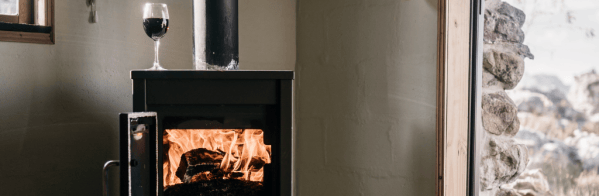
Cover image by Taryn Elliott: https://www.pexels.com/photo/wood-burning-stove-on-corner-side-of-a-house-8096682/