
This is a blog from Dr Tom Caygill, Senior Lecturer in Politics, Nottingham Trent University, who is working in the Scottish Parliament on a Scottish Parliament academic fellowship.
As with all guest blogs, what follows are the views of the author, not those of SPICe or indeed the Scottish Parliament.
This blog post summarises the findings of a research project on the post-legislative scrutiny undertaken by the Parliament during Session 5. The research is based on the analysis of 253 committee recommendations and subsequent government responses as well as interviews with MSPs and officials on certain committees which undertook post-legislative scrutiny during Session 5.
What is post-legislative scrutiny?
Post-legislative scrutiny is a valuable tool for the Scottish Parliament. In very simple terms it involves looking back at how previous legislation is working. There are two distinct functions to this, firstly monitoring the implementation of legislation and secondly evaluating whether the aims of an Act are reflected in the results and effects of the legislation once implemented. In the Scottish Parliament, parliamentary committees have the main post-legislative scrutiny role.
Session 5 overview
Despite some successes during previous sessions, it was determined by the Standards, Procedures and Public Appointments Committee in Session 4 that the extent of post-legislative scrutiny in the Parliament had remained limited. Part of the reason for this was that committees were struggling to conduct post-legislative scrutiny alongside their other work (e.g. bills and petitions). The Parliamentary Bureau, therefore, decided in 2016 that post-legislative scrutiny should be added to the remit of the Public Audit Committee (thus becoming the Public Audit and Post-Legislative Scrutiny Committee). However, this did not preclude other subject committees from undertaking such scrutiny.
This approach was designed to ensure that post-legislative scrutiny would occur even if other subject committees did not have capacity to complete any.
The Public Audit and Post-Legislative Scrutiny Committee undertook six inquiries during the five-year period, while the Local Government and Communities Committee undertook three inquiries and the Justice Committee and Environment, Climate Change and Land Reform Committee both undertook an inquiry each. A full list of the legislation which received post-legislative scrutiny is available in the SPICe briefing.
Notable inquiries included:
- The Local Government and Communities Committee selecting certain parts (parts 3 and 5) of the Community Empowerment (Scotland) Act 2015 to review rather than undertaking a review of the entire Act, which was considered too big to review in one go.
- The Justice Committee conducting scrutiny of the Police and Fire Reform (Scotland) Act 2012, which was a large piece of legislation.
Both committees provide suitable case studies for how to approach scrutiny of part or an entire Act.
While it is not possible to say how many subject committees decided not to carry out post-legislative scrutiny because of the Public Audit and Post-Legislative Scrutiny Committee’s new role, the fact that none were prevented from undertaking their own scrutiny suggests than an additional six inquiries were undertaken in this session.
Outcomes of post-legislative scrutiny
While there are multiple approaches to undertaking post-legislative scrutiny, the most prominent form is a dedicated inquiry reviewing either an entire Act or certain sections of an Act. Dedicated inquiries typically end with a written report containing recommendations for the Scottish Government. It is these outputs which we focus our attention on now. In total 253 recommendations were analysed from Session 5. Each recommendation was categorised for the type of action that the committee called for (Chart 1 below) and each corresponding response was categorised for the level of acceptance by the Scottish Government (Chart 2 below).
Chart 1: Type of recommendations

Chart 1 shows that most recommendations that committees made called for a change in policy or practice or for further research or reviews to be undertaken. The focus on policy and practice is not unusual. Previous research on post-legislative scrutiny in the UK Parliament found a similar approach. For several reasons policy and practice recommendations can be a useful landing zone for committees when recommending action.
Firstly, there is the possibility that the legislation which has been selected for review is operating effectively and that what is required is not legislative action but rather changes to the policy underpinning the legislation or to the implementation of that legislation.
Secondly, because governments are not required to accept or implement committee recommendations, there may be a tendency for committees to think realistically and focus on what they can achieve. A change of policy and practice is more straightforward for governments to accept.
Chart 2: Acceptance of recommendations

Chart 2 shows that most recommendations (60%) were accepted either in full or in part. Very few recommendations (10%) were rejected. This suggests a substantial level of success for committees in the Scottish Parliament and the success rate is around 20% higher than in the UK Parliament.
Although most recommendations require less political capital to accept and implement, this still represents a success for the committees involved and does show that they have a level of influence.
However, there is a significant minority of recommendations which do not appear to have received a formal response from the Scottish Government (17%). It should also be noted that the quality of responses did vary depending upon the policy area and Cabinet Secretary they were coming from. Some provided a full breakdown of each recommendation and a response in table form; others were simply letters and did not necessarily cover all recommendations flagged in the committee’s report. There is a need for more consistency here, particularly for the sake of accountability.
It is also worth noting though that just because an incumbent government does not accept recommendations in its response, this does not mean that: a) the same government will not implement them later, or b) that a new government will not pick them up upon entering office. This research is a snapshot of success within the first few months of an inquiry being completed.
Challenges – lack of time, politicisation, and knowledge retention
While there is evidence of impact and influence, several challenges were also identified.
The biggest factor which impacted on committees’ ability to undertake post-legislative scrutiny was lack of time. This was a result of the amount of government legislation which also needs to pass through the same committee system. The exception to this rule was the Public Audit and Post-Legislative Scrutiny Committee which did not have a legislative function; however, its audit function did come with a substantial workload too.
The politicisation of the post-legislative scrutiny process was also highlighted as an issue. Often the committee which worked on the original bill is also tasked with undertaking post-legislative scrutiny of the Act. While there is a benefit to this in terms of expertise, there is also the challenge that partisan disagreements over the Act rise again. What matters here is the framing of the activity, post-legislative scrutiny is about highlighting issues with the Act and identifying next steps, rather than pointing fingers. It is important though not to over-emphasise the politicisation of post-legislative scrutiny as the issues involved will almost always be political. Identifying what has worked as intended and what has not is politically subjective. It is one of the reasons that I advocate for parliaments to undertake post-legislative scrutiny as opposed to law commissions or other independent bodies.
Knowledge retention was also highlighted as a particular challenge. Clerking teams and Members rotate at the start of each new session and of course retirement and political reshuffles have an impact too. This raises the question of how the Parliament can retain knowledge of legislation (or issues relating to legislation) which may require review in the future. Often issues are raised in oral evidence sessions not linked to post-legislative scrutiny and those ideas for future scrutiny can get lost in the inquiry process.
Conclusion
There is evidence of impact from the post-legislative scrutiny undertaken during Session 5. There is also evidence that the extra capacity that the Public Audit and Post-Legislative Scrutiny Committee provided was beneficial in expanding the number of post-legislative scrutiny inquiries undertaken. The eleven inquiries undertaken in Session 5 was the highest number undertaken in one session up until that point.
There is scope for further enhancement, however.
Given the remit to undertake post-legislative scrutiny was removed from the Public Audit Committee in Session 6, the Parliament could trial the use of an ad hoc committee to undertake post-legislative scrutiny. This would have the benefit of temporarily expanding capacity.
Given the percentage of recommendations which do not receive a response from the government, the Parliament could also encourage the standardisation of government responses to committee reports to aid accountability.
Finally, given the issues of knowledge retention, the Parliament could develop a repository where both institutional knowledge of post-legislative scrutiny could be stored, alongside ideas/candidates for future scrutiny.
These actions could help to enhance the post-legislative scrutiny processes in the Parliament further.
Dr Tom Caygill, Scottish Parliament Academic Fellow
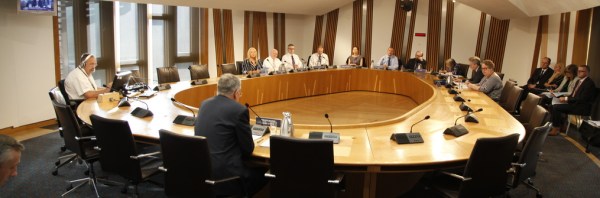
Cover image source: SPICe