
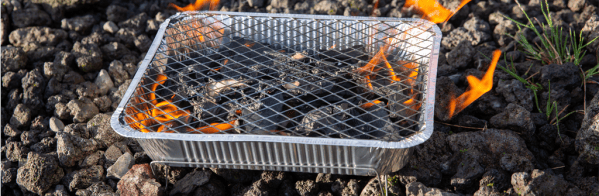
Following the wildfire in the Cairngorms, SPICe has received several enquiries regarding possible legislation and regulations to ban the sale of disposable barbecues (or ‘BBQs’) in Scotland.
This blog looks at potential legislative approaches which could be used by the Scottish and UK Governments to introduce such a ban, as well as current regulations and guidance on the use of barbecues in dry weather.
The blog was updated on 17 August 2026 to reflect updated guidance issued by the UK Government following the blog’s original publication.
What was announced by the UK Government on 14 August 2026?
The UK Government introduced statutory guidelines in relation to the supply of disposable BBQs on 14 August 2026, under the General Product Safety Regulations 2005 (GPSR) which apply in Great Britain. The guidelines apply in Scotland, England and Wales and following the guidelines is “strongly recommended for businesses producing or distributing such products placed on the Northern Ireland market”.
The guidance effectively temporarily bans the sale (online or in store) of disposable BBQs. A disposable BBQ is defined in the guidance as “a product designed for domestic single-use only, outdoors, not intended for re-filling or reuse. Comprising of fuel tray, grill grid and including charcoal fuel sufficient to provide sufficient cooking temperature for the duration of a single cooking episode.”
The guidance states:
To be considered safe under GPSR, a product must not present any risk or only the minimum risks compatible with the product’s use, considered to be acceptable and consistent with a high level of protection for the safety and health of persons, under normal or reasonably foreseeable conditions of use.
The [UK] Government’s view is that reasonably foreseeable uses of disposable barbecues during an extreme heat event or drought pose an unacceptable risk to the safety and health of the public.
Therefore, disposable barbecues cannot be considered a safe product in the context of the ongoing weather and environmental conditions, and must not be made available for sale either in store or online at the current time.
The guidelines apply immediately and state that they “will be kept under review, and will be withdrawn in consultation with relevant departments and agencies, as weather conditions change sufficiently to significantly reduce the risks”.
Wildfire risks and barbecues in Scotland
The Scottish Fire and Rescue Service (SFRS) advice is to avoid using barbecues on flammable surfaces or near vegetation during prolonged dry weather. The SFRS webpage on wildfires indicates that most wildfires are started by human activity, most commonly due to:
• unattended flames including “barbecues, campfires, and bonfires”
• glass bottles, i.e. sunlight shining through a glass bottle
• controlled burns for land management, which have gone out of control
• deliberate fire setting
• careless cigarette disposal
• dry weather conditions.
The debate around disposable barbecues is part of a wider current discussion about managing and responding to wildfire risk. On 3 June 2026, the Scottish Government set out details of campaigns designed to strengthen public awareness of wildfire risks in Scotland this summer.
What are the current restrictions and guidance on the use of disposable barbecues?
Scottish National Park Authorities can introduce byelaws to ban the use of barbecues at times of high risk. A byelaw has been implemented this year banning fires and barbecues in the Cairngorms National Park between 1 April and 30 September each year (with exceptions). There is more information on the Cairngorms National Park website.
Seasonal byelaws also restrict the use of fires in designated camping management zones in the Loch Lomond and the Trossachs National Park (these are currently being reviewed by the Park Authority).
Scottish local authorities have powers under the Local Government (Scotland) Act 1973 (‘the 1973 Act’) to make byelaws “for the good rule and government” of their area, and for the prevention and suppression of nuisances. The Natural Environment (Scotland) Act 2026 (‘the 2026 Act’) amends the 1973 Act to set out that “a local authority may make byelaws in connection with the prevention of wildfire (including, in particular, by prohibiting or regulating the lighting and control of a fire or any activity likely to cause a fire)”. The aim of this was to put beyond doubt that byelaw-making powers could be used in this way.
The 2026 Act also enables Scottish Ministers to make regulations to allow National Park Authorities and local authorities to enforce these byelaws by issuing fixed penalty notices, i.e. fines (these provisions are not yet in force but are expected to be commenced later this year).
The Land Reform (Scotland) Act 2003 established a statutory framework of public access rights to most land, with access rights based on the principle of responsible access. The Scottish Outdoor Access Code offers guidance on responsible access.
The guidance recognises that lighting fires and having BBQs are part of public enjoyment of the outdoors, but states that “over recent years there have been heightened concerns about risks from a range of factors coming together”, including new types of fire-related equipment, increased numbers of people, and concerns about risks to the environment and public safety. It states that climate change is having an impact on weather with associated higher fire risks, evidenced by some significant wildfires.
The guidance also includes information on criminal offences that could apply in relation to irresponsible use of fires (under the Trespass (Scotland) Act 1865, the Civic Government (Scotland) Act 1982 and the Roads (Scotland) Act 1984).
Who can legislate to ban the sale of disposable barbecues?
As set out above, the UK Government has now issued statutory guidance effectively prohibiting the current supply of disposable BBQs, using powers under product safety regulations. Product safety standards are generally a reserved area.
Scottish Ministers have powers to introduce regulations under section 140 of the Environmental Protection Act 1990 to prohibit or restrict the importation, use, supply or storage of injurious substances or articles to prevent them from polluting the environment or harming human, animal or plant health. These powers have been used to restrict the sale of certain single-use plastics, single-use vapes and most recently the sale of plastic wet wipes to the public (coming into force in 2027). In practice, these restrictions, whilst delivered through Scottish legislation under devolved powers for environmental protection, were agreed as part of UK-wide approaches.
New product restrictions, such as a ban on single-use items, may engage the market access principles in the UK Internal Market Act 2020 (UKIMA) and as such require either a UK-wide approach or an agreed exclusion from the UKIMA principles in order for any restrictions in Scotland to be effective in practice. Product restrictions can also interact with reserved areas such as product standards.
The Session 6 Scottish Government set out its position on this matter in response to a Scottish Parliament petition calling for a ban on the sale and use of disposable barbecues, considered by the Citizen Participation and Public Petitions Committee.
In correspondence to that Committee on 3 December 2025, the Scottish Government said:
“While the Scottish Parliament has the relevant powers under section 140 of the Environmental Protection Act 1990, as previously outlined, UKIMA could impact the effect of any new legislation those powers could be used to make.
In circumstances where the Scottish Parliament legislates to ban the sale and supply of a product, UKIMA could limit the legal effect of any such provision, given that items entering Scotland from elsewhere in the UK could still be legally placed on the market. Following a statutory review of UKIMA, new processes have been proposed by the UK Government to agree exclusions to the Act, principally through an administrative process under the relevant Common Framework. Notwithstanding any potential improvement under that process, without securing an exclusion to UKIMA, the legal effect of devolved legislation regarding the sale of disposable BBQs remains uncertain, however, it will be kept under review for all products”.
The letter went on to say: “There are currently no immediate plans to ban the sale of disposable barbecues in Scotland to achieve circular economy outcomes”, adding that in relation to wildfire risk more broadly, the Scottish Government is exploring public awareness campaigns, reviewing fire bans and byelaws and promoting responsible access. It is also considering a ‘yellow-amber-red’ graduated warning system to improve public understanding. It is anticipated that this may mirror flood and storm alerts, with the aim of helping the public and responders understand risk levels and take appropriate action.
On 1 August 2026, Jon Pearce MP was reported to have written to large retailers asking for the sale of disposable barbecues to be suspended ‘for the remainder of this summer while the risk of wildfires remains exceptionally high’, adding that the UK Government needed to introduce a ban on their use in public spaces. Most big supermarkets had already paused sales and some, like Lidl and Marks and Spencer, reportedly haven’t sold them since 2022.
Following an emergency COBRA meeting on high temperatures and wildfire risk, on 12 August 2026, the Prime Minister was reported to have urged “‘all retailers big and small’ to adhere to voluntary guidance to suspend sales during extreme heat”. He added that “in the ‘longer term’ the government would look at potentially banning the single-use grills during summer months”. On 13 August 2026 the Welsh First Minister was reported to have endorsed this approach.
Have there been previous attempts to ban the sale of disposable barbecues in the Scottish or UK Parliaments?
In 2023, a UK Parliament Private Member’s Bill sought to prohibit the use of disposable barbecues on open moorland, on beaches, in Areas of Outstanding Natural Beauty and in certain other areas designated for environmental protection in England, and to give English local authorities the power to prohibit the sale of disposable barbecues in their area. The Disposable Barbecues Bill did not progress beyond its first reading.
Parliamentary petitions
Petitions have been raised in both the Scottish and UK Parliaments calling on them to ban the sale of disposable barbecues.
PE2175: Immediate ban on the sale and use of Disposable (Instant) Barbeques in Scotland
As set out above, a petition was lodged in the Scottish Parliament on 14 July 2025, calling for legislation banning the sale of disposable barbecues by retailers and introducing on the spot fines for anyone using a disposable barbecue in Scotland. The petition was closed by the Citizen Participation and Public Petitions Committee on 29 October 2025, but the Committee agreed to write to the Scottish Government. The Scottish Government responded in the letter dated 3 December 2025 as mentioned above.
Ban on sale of disposable BBQs
The issue has also been raised in petitions to the UK Parliament.
Most recently, a petition lodged on 15 June 2026, asks the UK Government to:
1. Introduce a UK-wide ban on the sale of disposable BBQs
2. Encourage safer, reusable alternatives through public guidance
3. Work with retailers to support the transition away from single-use outdoor cooking products.
As of 14 August 2026, the petition has been signed more than 10,000 times and so will require a response by the UK Government.
Lindsay Paterson and Jennifer Bruce, Enquiries Officers, and Alexa Morrison, Senior Researcher
Blog image from Adobe Stock