

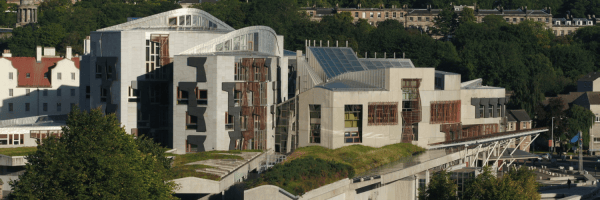
As the Scottish Parliament returns from summer recess, SPICe has taken the opportunity to reflect on parliamentary business during the previous session.
This two-part blog draws on data published annually in the Scottish Parliament Statistics volumes and Fact Sheets, covering the period from the start of Session 6 on 12 May 2021 to the dissolution of the Scottish Parliament on 9 April 2026.
The blog highlights selected insights from the data and is not intended to provide an exhaustive or comprehensive analysis of parliamentary activity during Session 6.
Statistics are presented both for Session 6 as a whole and by parliamentary year (PY). A parliamentary year is a period, normally of 12 months, beginning on the date of the Parliament’s first meeting following a general election and on each subsequent anniversary of that date throughout the session.
2021 Election
The Scottish National Party (SNP) was the largest political party in the May 2021 election, winning more than double the seats of the second placed party, the Scottish Conservative and Unionist Party.
- SNP won 62 of their total seats in the constituency vote.
- Scottish Liberal Democrats won all four of their seats in constituencies.
- Scottish Labour Party and the Scottish Conservative and Unionist Party won most of their seats via the regional list.
- Scottish Green Party won all eight of their seats via the regional list vote.
The state of the parties changed considerably over the session, with a number of MSPs leaving the party they were elected to represent and joining a different party or becoming an independent MSP.
No independent MSPs were elected in May 2021, however at dissolution there were seven independent MSPs in the Scottish Parliament.
All parties except the Scottish Liberal Democrats saw a reduction in their numbers as the session progressed. The Scottish Liberal Democrats increased their seats from four to five when Jamie Greene MSP resigned from the Scottish Conservative and Unionist Party and joined them in April 2025.
132 people served as an MSP in Session 6.
42 MSPs who were serving at the end of Session 6 chose not to stand for re-election in May 2026.
Chamber business
The COVID-19 pandemic continued to have a significant impact on how the Parliament conducted business at the start of Session 6. Hybrid arrangements for MSPs conducting parliamentary business in committees and the Chamber remained, and remote voting continued.
The total amount of time spent in the Chamber in Session 6 was 2,374 hours 38 minutes.
Year | Time |
|---|---|
PY1 2021/2022 | 468:04 |
PY2 2022/2023 | 468:49 |
PY3 2023/2024 | 464:07 |
PY4 2024/2025 | 466:54 |
PY5 2025/2026 | 506:44 |
S6 Total | 2374:38 |
The average plenary meeting time for the session was 4 hours 27 minutes.
The amount of time considering legislation in the Chamber rose considerably in the final year of Session 6 with over 181 hours spent on Bills. This compares to 30 hours spent on Bills in the first year of the session.
The largest amount of time spent in the Chamber each parliamentary year was on motions for debate, with the exception of the final year, when more time was spent on Bills.
Over 81 hours was spent on Ministerial statements in PY1 2021/2022. This reduced to 34 hours in PY5 2025/2026.
Out of a total of 1,147 debates across Session 6, 278 (24.2%) were on health topics – the highest number of all subject areas.
Unsurprisingly, COVID-19 continued to be topical in the Chamber, with many Ministerial statements and debates on the subject.

Parliamentary Questions
Parliamentary questions are one way in which Members can obtain factual and statistical information from the Scottish Government or the Scottish Parliamentary Corporate Body.
There are two types of parliamentary questions:
- written questions, which receive a written response
- oral questions which are answered in the Chamber.
During Session 6, a new approach to parliamentary questions was introduced at the end of summer recess 2023. The Presiding Officer Alison Johnston MSP wrote to all Members to set out time limits for asking and answering questions in the Chamber. This new approach meant questions would be put within 45 seconds and answers concluded within one minute. This resulted in an immediate increase in the number of questions asked, with a particular impact on those put to the First Minister at First Minister’s questions (FMQs).
A total of 1,067 questions were taken at FMQs across Session 6.

Motions
Motions are used by MSPs to start a debate or propose a course of action. They are also used to highlight local issues and achievements or agree parliamentary business.
On 26 April 2024, the first ever Motion of No Confidence in the Scottish Government was lodged; it was taken in the Chamber on Wednesday on 1 May 2024 where the motion was disagreed to.
A total of 21,662 motions were submitted in Session 6. The number submitted each parliamentary year was consistent throughout the session.
Year | Number of motions |
|---|---|
PY1 2021/2022 | 4,446 |
PY2 2022/2023 | 4,633 |
PY3 2023/2024 | 4,345 |
PY4 2024/2025 | 4,444 |
PY5 2025/2026 | 3,794 |
S6 Total | 21,662 |
The last plenary meeting of the session was held on 25 March 2026 and concluded with the Presiding Officer’s closing remarks.
The Parliament was dissolved on 9 April 2026. Dissolution marks the formal end of a session of the Scottish Parliament and brings parliamentary business to a halt until a new Parliament is elected and convened.
Part two of the blog looks at Session 6 committee business, more on legislation and other parliamentary business.
Rebecca Bartlett, Julia Hurst, Emma Robinson, and Gwynneth Cowley
SPICe