
COP28, in Dubai, United Arab Emirates (UAE), was the 28th Conference of Parties (COP) on climate change and, after some delay in reaching an agreement, concluded on the 13th of December. This blog summarises some of the major talking points from this year’s negotiations and considers how they relate to the Scottish context.
Background
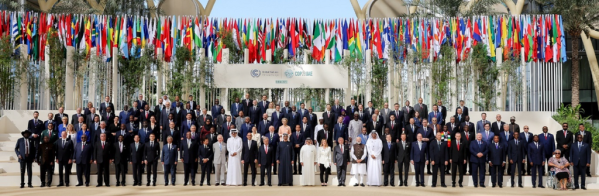
Held in Expo City, a $7billion conference centre covering over 1,000 acres, and with around 100,000 attendees, COP28, was the first COP to include a Global Stocktake; an assessment of the global response to climate change – reducing emissions, adapting to climate impacts and the development of finance. It has been anticipated since the 2015 COP in Paris, where the goal was set of:
- ‘Holding the increase in the global average temperature to well below 2°C above preindustrial levels and pursuing efforts to limit the temperature increase to 1.5 °C above pre-industrial levels’.
COP negotiations involve 198 nation states and have taken place for 30 years. They are the foremost attempt to address the collective action problem of climate change; that it is in everyone’s interest to cooperate and reduce emissions but conflicting economic and social interests discourage this from happening. The latest Intergovernmental Panel on Climate Change (IPCC) synthesis report concluded some climate change is ‘unavoidable and/or irreversible but can be limited by deep, rapid and sustained global greenhouse gas emissions reduction’.
From a parliamentary perspective, COP28 was the first with a dedicated parliamentary pavilion. This was run by GLOBE International a cross-party network of parliamentarians focused on sustainable development governance. There were two Scottish Parliament events at the pavilion relating to the importance of legislatures in tackling climate change.
Role of the UAE presidency
The choice of the UAE as host was criticised by some due to their substantial vested interest in the oil and gas industry; the COP president is the chief executive of the state owned oil company. Others, however, observed that it is necessary for all nations to achieve net zero and thus even oil-rich states must play a role. Reservations were amplified before the event got started after it emerged that briefing documents for UAE officials encouraged them to discuss making fossil fuel deals during their COP 28 meetings.
The belief that there is still a future for the exploitation of fossil fuels as the world moves to net zero greenhouse gas (GHG) emissions, is one that came to heavily influence proceedings and the debate around the final agreement text.
Net zero, fossil fuels and carbon capture
The most debated part of the finally agreed text related to the future use of fossil fuels on the way to net zero GHG emissions. Throughout the event discussions focused on whether there should be commitment to ‘phase out’ or to ‘phase down’ fossil fuels by 2050. Although there is some ambiguity surrounding these terms, roughly they can be defined as ending the use of fossil fuels or merely reducing it. The combustion of fossil fuels is responsible for about three quarters of current global greenhouse gas (GHG) emissions.
A similar discussion had taken place at COP26 in Glasgow around the use of coal, with the text there ultimately moving from pledging to phase out coal power to ‘the phasedown of unabated coal power’.
In the end, the final relevant agreed text for COP 28 read:
- ‘Calls on Parties to contribute to the following global efforts … Transitioning away from fossil fuels in energy systems in a just, orderly and equitable manner … so as to achieve net zero by 2050 in keeping with the science’
Many net zero scenarios (including those produced by the IPCC) do have some amount of fossil fuels used in 2050 The International Energy Agency (IEA) have, however, been stating since 2021 that if 1.5oC is to be achieved there can be ‘no new investments in oil, gas and coal, from now’ (2021), an approach that would see the eventual cessation of fossil fuel use.
The only way fossil fuel combustion and net zero can co-exist is via the utilisation of carbon capture and storage (CCS) technology. The IPCC scenario in question would require a lot of CCS, and the body themselves have warned that the development of CCS technologies have been ‘much slower than projected in previous assessments’ and ‘implementation faces technological, economic, institutional ecological-environmental and socio-cultural barriers’.
Scotland has been a case study in ‘slower than projected’ progress, with the use of CCS highly relevant to its net zero plans. The climate change plan update in 2020 had negative emission technologies (in Scottish Government policy these currently rely on CCS) reducing overall emissions by 16% by 2030 and 24% by 2032. Scottish plans for CCS have not been proceeding at the required pace, although the Acorn project recently received backing from the UK Government. Scottish Government commissioned research published in November 2023, finds that a maximum potential of 10% by 2030 is now possible, but only with concerted policy intervention from both the UK and Scottish Governments.
It is worth noting that the COP28 Agreement is not binding and that there were also many other discussions and agreements at the event. The wording is seen as important as a means of signalling and building confidence in the direction of travel. The wording on fossil fuels was contentious as it is seen as reflective of the level of seriousness globally, on limiting climate change.
While highly significant, the combustion of fossil fuels is not the only source of emissions. The role of agriculture (COP28 saw greater recognition of the role of food systems in climate change) and potential natural carbon sinks – forests, wetlands and peatlands – is critical, with their impact still subject to revision with developing evidence (see peatland emissions in Scotland). The climate scientist Johan Rockström observed during COP28:
- ‘“The climate models that give us a remaining carbon budget for an orderly phase out of oil, coal and gas have assumed that nature will not surprise us. And now nature is surprising us so of course that makes us very worried.”
Triple levels of renewable energy
Other major agreements at COP 28 included a ‘Global Renewables And Energy Efficiency Pledge’ which commits in part to:
- ‘Commit to work together to triple the world’s installed renewable energy generation capacity to at least 11,000 GW by 2030, taking into consideration different starting points and national circumstances’
This level is based on an estimate of what is required by the International Energy Agency.
The text highlights the importance of different starting points. There is considerable renewable energy deployment in Scotland already, mainly entailing renewable electricity (there are net exports of about a third of Scottish electricity production). As regards renewable electricity capacity, Scotland currently has 9.4GW of onshore wind, 2.7GW offshore wind, 1.6GW of hydro, 0.5GW of solar and 0.5GW bioenergy & waste (14.8GW of renewable capacity in total). The Scottish Government has 2030 targets for offshore wind (8-11GW), onshore wind (20GW) and solar (4-6GW). If all these targets were achieved it would mean more than a doubling of capacity (35GW) and there is also potential for new hydro (Coire Glas and Cruchan expansion). So, even with a history of substantial renewable electricity deployment, Scottish ambitions to 2030 are not dissimilar to the COP28 renewables pledge.
Loss and damage funding and other developments
The early news from the conference was the agreement of further loss and damage funding. The principle of loss and damage relates to the actual impacts from climate change and how they could be financially compensated for. At around $700m, loss and damage pledges have grown but they are still orders of magnitude less than estimated impacts of climate change (and also less than the world’s top footballers get paid).
At COP26, Scotland became the first country to commit to a specific loss and damage fund and at this COP commitments were made to fund renewable energy projects in Malawi, Zambia and Rwanda.
Current projected level of climate change
This was the Global Stocktake COP and while the COP president pledged to keep ‘1.5 alive’ there is widespread scepticism as to whether this is possible. It would require a roughly, 50% drop in CO2 emissions by 2030, 80% by 2040 and 100% by 2050 (from a 2019 base). At the moment, global emissions are still rising – although the growth rate is slowing and the IEA have reiterated that they expect energy-related CO2 emissions to peak in 2025.

Source: Glen Peters, Centre for International Climate Research. Post on twitter
Global efforts at climate mitigation, as crystallised by COP28, provide the context that the Scottish net zero target is not arbitrary, it is part of a necessary global undertaking. The legislated targets for Scottish emission reductions are more ambitious than the global effort – they are in respect to all GHGs, rather than CO2 (and nearly a third of Scottish GHG emissions are non-CO2) and they are for net zero by 2045. Against 2019 levels and for all GHGs, Scottish targets involve a reduction of 55% by 2030 and 100% by 2045.
Taking into account all current policies internationally the world is projected to see about 2.7°C of warming. Despite two COPs taking place since, this projection has not changed since 2021. Other projections estimate the impact of current policies to be 3oC. The difference in impacts between 1.5oC and 3oC would be significant:
- Globally, the ‘proportion of time in drought nearly doubles at 1.5oC, and at 3°C it more than triples’
- In Britain, ‘the average annual likelihood of a heatwave as defined by the Met Office increases from around 40% now to around 65% at 1.5°C and over 90% at 3°C’.
Only time will tell whether the eventual and hotly debated wording of the COP28 agreement, has any impact on these projections.
Niall Kerr, Senior Researcher, Climate Change and Net Zero