
The National Outcomes that form part of the National Performance Framework (NPF) are currently being reviewed and proposed changes have been laid in Parliament. This blog sets out information on the NPF and the current review of Outcomes.
What is Scotland’s National Performance Framework?
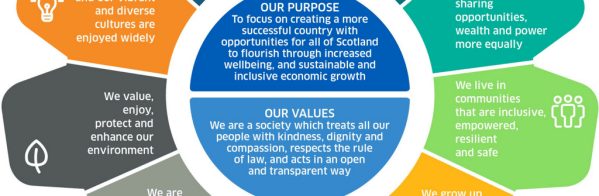
The National Performance Framework (NPF) is a strategic tool introduced by the Scottish Government in 2007 that “sets out a vision for the collective wellbeing of Scotland”. It is intended to align with the United Nations Sustainable Development Goals to ensure a balanced approach to economic, environmental, and social progress.
The NPF currently outlines eleven National Outcomes that articulate the kind of country the Scottish Government would like Scotland to be, with a focus on improving the lives of people in Scotland. These outcomes are measured by a set of 81 National Indicators, to “understand if we are moving in the right direction towards them” as explained by the Scottish Government.
The framework’s values are intended to promote transparency, kindness, and respect, guiding decision-making processes and behaviours towards achieving these outcomes. The NPF aims to encourage collaborative efforts, with the intention being that organisations work in partnership to plan and implement strategies that align with the framework’s collective objectives, with the aim of shaping the quality of life for individuals and communities across Scotland.
Performance against current Outcomes
To help understand Scotland’s progress in relation to the NPF Outcomes, performance is measured using the 81 indicators. However, it should be noted that, as of 5 March 2024, of the 81 National indicators there is no data for 17. The indicators help to simplify a complex array of statistical measures and get a sense of the overall direction of the NPF and whether each indicator’s performance is improving, maintaining, or worsening.
Of the 61 indicators where performance can be measured:
- 29 show performance maintaining
- 24 show performance improving
- 11 show performance worsening
Current gaps in data are notable in Education (no performance data for four out of nine Indicators), Human rights (no performance data for three out of four indicators), Communities (no data for two out of eight indicators) and for International (no performance data for three out of six Indicators).
The following chart produced by SPICe gives an overview of what is happening with each indicator grouped by its relevant outcomes.

SPICe presents this data in more detail in a separate blog How is Scotland Performing? which is updated monthly.
The Statutory Review
The statutory Review of National Outcomes
The Community Empowerment (Scotland) Act 2015 requires that the National Outcomes be reviewed every five years. In line with this, a review of the National Outcomes began in May 2022 with the public engagement phase running March to June 2023. The SPICe blog Review of the National Outcomes 2023 – Back to the future? provides more detail on the review through to June 2023.
Analysis and development of changes to the National Outcomes was followed by approval from Scottish Government Cabinet for the proposed changes.
On 1 May 2024 the Consultation with Parliament in connection with the Review of National Outcomes was laid before the Scottish Parliament by the Scottish Ministers.
Key themes in the Review
The statutory Review of the National Outcomes revealed diverse views on whether the current National Outcomes are appropriate. The Scottish Government analysis showed a higher percentage of respondents from the written consultation were positive about the current individual Outcomes compared to the current set of Outcomes which suggests that there were themes missing from the set of outcomes as a whole. Further analysis highlighted missing themes from the existing eleven outcomes including care, transport, housing, wellbeing economy, reducing inequalities, mental health, and climate action.
According to respondents, these themes reflect the most pressing issues of modern Scotland. The Scottish Government wanted any proposed new outcomes, or changes to existing outcomes to meet the following criteria:
- Population level theme – applies to everyone
- Contributes to wellbeing of people and planet/human flourishing
- Describes an outcome not a process
- Distinct enough from the other National Outcomes
- Improved alignment with the UN’s Sustainable Development Goals
This evidence informed the development of proposals for new Outcomes and revisions to existing Outcomes.
The written consultation also identified common barriers to implementing the National Outcomes, such as policy coherence, a complex reporting landscape, and difficulties in driving changes through the NPF. Dissatisfaction with current funding models was also a concern. Stakeholders expressed support for a Wellbeing and Sustainable Development Bill and called for increased accountability mechanisms, including clarifying roles and responsibilities, better scrutiny, and improved government transparency.
Overall, the Review highlights the need to strengthen the National Outcomes to better reflect the desires of Scotland. It suggests that prioritising areas like care, transport, housing, wellbeing economy, reducing inequalities, mental health, and climate action can lead to a more comprehensive framework. Additionally, addressing barriers to implementation and enhancing accountability mechanisms can improve the effectiveness of the National Outcomes.
Proposed changes to the National Outcomes
The recently laid statutory report proposes a series of changes to the NPF and National Outcomes. These include three additional proposed outcomes, Care, Climate Action, and Housing, taking the total number of outcomes to 13 (with the previous ‘Economy’ and ‘Fair Work and Business’ Outcomes combined into a single Outcome). Additionally, nine of the National Outcomes have been amended and all the National Outcomes have proposed changes to their extended definitions. National Indicators will be revised to reflect the changes to the National Outcomes once changes have been agreed by Parliament.

It will be imperative for the Government to choose relevant and quantifiable Indicators which allow the proposed Outcomes to be effectively measured and scrutinised. This allows for the Government, Parliament, and the public to understand whether the initiatives put forward by the Government are effective. Specifically, this supports outcomes-based budgeting and scrutiny bringing Scotland closer to OECD best practice.
New Outcomes proposed in the National Performance Framework
The review proposed the addition of three new outcomes: Care, Climate Action, and Housing. It also proposed the joining together of the Economy and Fair Work and Business Outcomes into one Outcome: Wellbeing Economy and Fair Work.
Care
“We are cared for as we need throughout our lives and value all those providing care.”
The ‘Care’ outcome has been added as it is “an essential aspects of social and economic wellbeing” aiming to reduce inequalities by supporting caregivers and care recipients. This move also considers insights from gender-based analyses to better recognise contributions traditionally made by women. Evidence was provided by Oxfam Scotland, Scottish Women’s Budget Group, Carers Scotland, Scottish Care and One Parent Families Scotland, and supported by over 50 organisations.
Climate Action
“We live sustainably, achieve a just transition to net zero and build Scotland’s resilience to climate change.”
The ‘Climate Action’ has been added to better align with the Sustainable Development Goals and to highlight the critical nature of the climate crisis. It aims to ensure a fair transition to net-zero emissions and enhance Scotland’s climate resilience by promoting renewable energy, sustainable food systems, and green transport options. The focus also includes fostering resilience to climate change, supporting the shift towards green jobs, and advocating for a circular economy. This allows the ‘Environment’ outcome to concentrate on the active conservation and improvement of the natural environment.
Housing
“We live in safe, high-quality and affordable homes that meet our needs.”
The ‘Housing’ outcome has been added as the Scottish Government. This Outcome underscores that secure, affordable, safe, and suitable housing is foundational to well-being through its impact on many other aspects of life. Evidence was provided by housing organisations as well as various organisations including Crisis, Homeless Network Scotland, Shelter Scotland, Public Health Scotland and the Association of Local Authority Chief Housing Officers.
Wellbeing Economy and Fair Work
“We have a competitive, entrepreneurial economy that is fair, green and growing, with thriving businesses and industry and fair work for everyone.”
The Wellbeing Economy and Fair Work Outcome brings together the Economy Outcome and Fair Work and Business Outcome. This Outcome focuses on collective wellbeing and sustainability, it includes improving living standards and job quality. It champions green innovation, digital and transport connectivity, and fair work practices. According to the Scottish Government, the approach aims to reduce inequality and foster economic participation, ensuring equitable wealth distribution and environmental protection.
What’s Next?
Now that the proposed outcomes have been laid in Parliament, the Parliamentary scrutiny process will proceed as follows:
- The Finance and Public Administration Committee will lead the review of the National Outcomes, inviting other committees to consider what further scrutiny they may wish to undertake on evidence received relating to their remit.
- A joint call for views will be launched behalf of all Committees to elicit views on the proposed outcomes from stakeholder organisations and the wider public. SPICe will analyse the submissions to this Call for Views.
- Individual Committees will be invited to consider the SPICe analysis and whether to take further evidence on issues within their remit. Committees can report their views along with the report of the Finance and Public Administration Committee.
- The Parliament then debates on a committee motion, the Finance and Public Administration Committee report along with any reports from other Committees. This forms the Parliament’s consultation response on the proposed National Outcomes.
SPICe will continue to monitor developments and share relevant research.
Kelly Eagle, Senior Researcher, Financial Scrutiny Unit