
In January 2024, SPICe published a blog about work to deliver a model for parliamentary scrutiny of climate change. This covered the work of the Conveners Group – made up of the MSPs that convene each of the Scottish Parliament’s 15 Committees, and chaired by the Deputy Presiding Officer – and its Session 6 strategic priority on climate change and net zero. It highlighted that as part of its work to support and encourage other committees to effectively embed climate scrutiny in their own work, the Net Zero, Energy and Transport Committee (NZET) was establishing a People’s Panel on Scottish Government public engagement on climate change.
As the Parliament concludes its latest People’s Panel on reducing drug harm and deaths in Scotland, this blog provides an overview of the Climate Change People’s Panel a year on, and how its considerations and evidence have informed parliamentary scrutiny to date.
Why is the Parliament piloting the use of People’s Panels?
A People’s Panel is a form of deliberative public engagement, which brings together a randomly selected and broadly representative sample of the population to learn about an issue, discuss it, and make recommendations.

Tackling climate change requires significant behaviour change to reduce emissions. Meaningful public engagement is well recognised as critical to realising climate change and net zero policy, shifting to more sustainable behaviours and ensuring a just transition. Research indicates that deliberative approaches have several benefits, including that they can make climate policy more robust and challenge embedded social and climate inequalities.
Within a Parliament, cross-cutting issues like climate change offer opportunities to approach scrutiny from a citizen’s perspective and to use public participation to inform work across Committees. As highlighted in a 2021 report by the Westminster Foundation for Democracy on Post-legislative scrutiny of climate and environment legislation, participative democracy can also bring greater insight and buy-in to parliamentary activities in these areas.
In the Scottish Parliament, alongside climate change and net zero, the Conveners Group has strategic priorities on participation, diversity and inclusion for committees, including embedding deliberative democracy in the work of Parliament, and enhancing the level of post-legislative scrutiny. In its report on Embedding public participation in the work of Parliament in September 2023, the Citizen Participation and Public Petitions Committee recommended two further pilots of ‘people’s panels’ in the remainder of this session, one on a policy question and one on post-legislative scrutiny, to test the value of this form of public input to post-legislative scrutiny. There is an overview of developments in these respective areas in the SPICe Spotlights on Embedding Deliberative Democracy in a Participatory Parliament and Institutionalising Post-Legislative Scrutiny, both published in November 2023.
In September 2023, the NZET Committee agreed to carry out post-legislative scrutiny of section 91 of the Climate Change (Scotland) Act 2009, which places a duty on Scottish Ministers to have a public engagement strategy on climate change. As part of this, in October 2023, NZET successfully proposed to the Conveners Group that the Committee establish a deliberative democracy exercise involving a people’s panel.
Establishing a People’s Panel on Scottish Government public engagement on climate change
The People’s Panel was established to discuss and respond to the questions:
- How effective has the Scottish Government been at engaging the public on climate change and Scotland’s climate change targets?
- What else (if anything) could the Scottish Government do to inform and involve the public to help meet Scotland’s climate change targets?
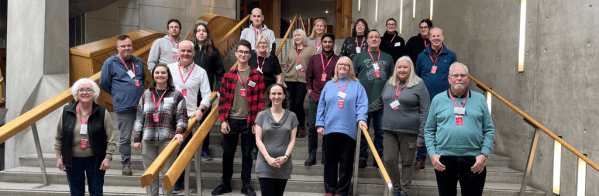
A Stewarding Board, comprising experts in relevant fields, was appointed to help ensure the fairness, credibility, and transparency of the process. Recruitment of the panel itself was designed to achieve diversity and inclusion, with participants broadly reflecting Scotland’s demographics across gender, age, region, ethnicity, disability, educational level, and attitudes towards climate change. The twenty-three panel members travelled to the Scottish Parliament to meet and exchange views with experts and committee members over two weekends and two online sessions in February and March 2024. The process involved learning about the topic, questioning witnesses, deliberation, consensus-based decision-making and team building.
Full information on the Stewarding Board, participant recruitment and the People’s Panel process is available in the Report of the Scottish Parliament People’s Panel reviewing the Climate Change (Scotland) Act 2009, published in April 2024.
The findings of the People’s Panel
The panel agreed a collective statement and 18 recommendations to answer the questions they were set about the effectiveness of the Scottish Government’s engagement on climate change. In the collective statement the Panel agreed:
“There needs to be truth and honesty from the Scottish Government about the scale of the challenge, and a compelling vision of the better world we are all aiming for… The panel have considered all evidence they have heard and concluded that collaboration with expert local and community led organisations is the key to success… The panel recognise that change is not easy but needs to happen… The panel would like the Government to commit to understanding the action gap and barriers to participation.”

Closing the loop: impacts of the work of the People’s Panel to date
Alongside delivering People’s Panels, the Parliament’s internal Participation and Communities Team (PACT) and SPICe have been collaborating with academics to assess how effective its approaches to participatory and deliberative engagement are, how much influence they afford the public, and to develop a framework to measure impact. This includes through academic fellowships with Dr Adam Chalmers from the University of Edinburgh on Tracking public engagement through the parliamentary process, published in November 2023, and Dr Ruth Lightbody from Glasgow Caledonian University on Understanding the core principles of deliberative democracy and creating a framework for measuring impact, published in March 2024.
These highlight that there are different types of impact – from changing how things work and what happens (instrumental), how people think (conceptual) and what people do (capacity building). These different types of impact can take place in different areas – from public policy and political decision-making; public discourse and public, business and civil society engagement; and wider systemic effects on democratic systems. Achieving impact from participatory and deliberative engagement approaches is also dependent on the wider impact and influence of the parliament. Assessing parliamentary influence on the policy process can be difficult, since not all functions of a legislature are targeted at immediate policy change and their greatest influence can come through “anticipated reactions” – where the government takes action pre-emptively to avoid parliamentary challenge. Evaluating the effectiveness and impact of committees is a strand of the Standards, Procedures and Public Appointments Committee inquiry on Committee effectiveness, which is running a Call for Views until 22 April 2025.
This blog focuses on policy impacts and aims to show evidence of how the Panel’s work has shaped MSPs knowledge and understanding of diverse public perspectives on engaging the public on climate change, integrated public perspectives into policy issues and influenced legislation and policy.
Raising political profile: The Panel’s presentation of their findings to the NZET Committee and putting the report and recommendations to the Scottish Government
Raising the political profile of an issue is an important dimension of parliament’s influence. Participants presented their report and recommendations to the NZET Committee at a public evidence session on 16 April 2024.
The Convener ended the session by thanking and congratulating the Panel for their work and highlighting that the Panel’s work had increased their knowledge and understanding of what the people want, and that they would integrate findings from it into their scrutiny work of policy and legislation. Following this, the Committee wrote to the Cabinet Secretary for Wellbeing Economy, Net Zero and Energy on 2 May 2024, to formally share the report of the Panel and to seek the Scottish Government’s views on its conclusions and recommendations. The Cabinet Secretary responded on 23 May 2024, acknowledging the Panel’s “valuable work” and stating that:
“The Panel challenges the Scottish Government to strive to increase the consistency and reach of its engagement. We acknowledge the call for honesty about the scale of the challenge, consistent evaluation of projects and commitment to understand where action is needed and barriers to participation. We are seeking ways to address this as we review our current engagement strategy… I can confirm that the Panel’s report and recommendations will be used as part of this review to help shape and inform the remainder of the strategy’s implementation.”
The NZET Committee questioned the Cabinet Secretary at their meeting on 28 May 2024, and directly put the Panel’s recommendations to the Cabinet Secretary in relation to:
- Current and longer-term funding for climate action hubs
- Supporting people to take action, including through climate-friendly technologies such as installing heat pumps.
Given the resources and substantive time commitment required from citizens to take part in a People’s Panel, putting the Panel’s recommendations to Government might be seen as a minimum requirement for impact rather than the sought after longer-term effect. What comes next shows how Members of the NZET Committee have continued to use the Panel’s work to integrate public perspectives into their scrutiny work, which has led to changes in both policy and legislation.
Influencing the legislative process: The Climate Change (Emissions Reductions Targets) (Scotland) Bill
A widely cited quote by the political scientist David M. Olson is that “in most democratic legislatures’ there is something approaching ‘a “90 percent rule”: the Cabinet proposes at least 90 percent of the legislative agenda, and at least 90 percent of what it proposes is adopted”. However, whether legislation is passed does not in itself tell us whether parliament has influenced the process. Evidencing influence does require going into a bit of technical detail about the parliamentary legislative process though – and there’s a handy explainer on how a Bill, or prosed Bill, becomes an Act on the Parliament’s website.
In April 2024, at the time the Panel was concluding its work, the Cabinet Secretary accepted the Climate Change Committee’s (CCC) assessment that the “acceleration required in emissions reduction to meet the [interim] 2030 target is now beyond what is credible”. The Government announced plans to make ‘minor’ changes to climate change legislation, and a climate change policy package. Explored in the SPICe blog on A changing climate? The Scottish Government’s newly announced policy package, the policy package included direct reference to the work of the Panel:
“Following on from the climate assembly, and the report from the Committee’s People Panel on climate engagement, we will take forward a new assembly/participative process, which, unlike previous assemblies, will develop public understanding of the implications of the transition to net zero for Scottish households and businesses.”
Fast forward six months, and on 5 September 2024 the Government introduced legislation to amend its approach to setting targets for carbon emission reduction – the Climate Change (Emissions Reduction Targets) (Scotland) Bill. The Bill proposed a new framework for interim emissions reduction targets and changed the date by which the next Climate Change Plan (CCP) – the Government’s strategic delivery plan for meeting emissions reduction targets – was due. At that time, the legal deadline for laying the draft CCP in Parliament was November 2024.
In order to consider the Bill before the legal deadline for laying the draft CCP was reached, the Parliament agreed to undertake its scrutiny under an expedited (fast-tracked) timetable. Undertaking legislative scrutiny at speed is challenging. Although the NZET Committee had to undertake its scrutiny of the Bill over a very short timeframe, because the Panel had already reported, Members were able to use its findings to inform their considerations.
Stage 1
During Stage 1 scrutiny of the general principles of the Bill, the Panel’s work was integrated into the three oral evidence sessions the NZET Committee held:
- 10 September 2025, including on a potential gap between what is technically possible to enable net zero targets to be met, and the policy solutions that would enable a just transition.
- 17 September 2025, including on the importance of communication of the policies in the Climate Change Plan and how these will affect the way people live their lives and how to ensure that the Government undertakes meaningful public participation in its development of Climate Change Plans.
- 24 September 2025, including on whether any changes to the Bill could drive more public engagement work with communities.
The NZET Committee referenced the People’s Panel in their Stage 1 report on the Bill on 4 October 2024, and asked the Government to outline what proposals for public engagement and participation it had developed so far in relation to the preparation of the next CCP. It also recommended that that future draft and final CCPs must include “more accessible information which can engage the non-expert.” In its response on 9 October 2024, the Government stated that:
“We are committed to enabling the public to participate in climate policy development. We will work with our Climate Policy Engagement Network, bringing together a range of third sector, community and academic organisations and individuals to support the design of our engagement approach and provide insights on the next draft climate change plan. We have also established a national network of Community Climate Action Hubs through which we can work to engage the public across Scotland on the plan… We expect this engagement to continue to inform the draft CCP as it is developed.”
The Stage 1 debate, where the whole of the Parliament debate the Bill, took place on 10 October 2024. During the debate, Members of the NZET Committee drew on the Panel’s work. For example, Mark Ruskell MSP called on the Government to consider embedding deliberative approaches to public engagement in the Bill. Following the debate, the Parliament agreed that it should go on to Stage 2.
Stage 2
At Stage 2, any MSP can suggest amendments (changes), but only members of the Stage 2 committee can decide on them. Discussions on whether the Bill could be used as an opportunity to strengthen requirements for public engagement in the development of climate policy continued during Stage 2 scrutiny. For example, Mark Ruskell MSP brought forward amendment 19 to require Scottish Ministers to carry out public consultation to inform Climate Change Plans (though not applying to the next Plan due to the timescales) directly citing the work of the Panel. While this amendment was not voted on (for technical reasons), the Acting Cabinet Secretary responded that the Government “does and would do that anyway, but I have absolutely no objection at all to that being formalised” and offered to work with the Member ahead of Stage 3.
Stage 3
At Stage 3, any MSP can propose further amendments, and these are debated in the Chamber and all MSPs can vote on them. The discussion on public engagement continued during Stage 3 scrutiny. Mark Ruskell MSP put forward amendment 8, requiring Scottish Ministers to carry out public consultation to inform Climate Change Plans (again, not applying to the next Plan), and before this, to set out to Parliament the methods, communication and timescales for this. In the Stage 3 debate on 5 November 2024, the Cabinet Secretary supported the amendment and urged colleagues to do the same. Again, members of the NZET Committee referred directly to the work of the Panel in their contributions. For example, Monica Lennon MSP directly raised the recommendations of the Panel when stating her support of the amendment. The Parliament unanimously agreed to this amendment. Following the debate, the Bill was passed by the Parliament and became an Act on 22 November 2025.
The value of pester power: The Scottish Government’s mid-term review of their Public Engagement Strategy and 2025-2026 Budget scrutiny
Another way in which parliamentary committees can impact on Government is through ‘pester power’ – returning again and again to issues to keep them on the government’s agenda. In May 2024, the NZET Committee undertook a Scottish Government climate change and environmental governance stocktake. During the session, the Cabinet Secretary confirmed that the work of the People’s Panel would contribute to the Government’s own review of their Public Engagement Strategy (PES):
“I take this opportunity to thank the committee and the people’s panel for their contributions and recommendations. It is worth noting that we are due to conduct a review of our public engagement strategy on climate change, which we will do shortly, and the work of the people’s panel will feed into that.”
As part of its 2025-26 pre-budget scrutiny the Committee wrote to the Acting Cabinet Secretary in November 2024 to remind the Scottish Government about their commitment to respond the People’s Panel’s recommendations as part of their mid-term review of their PES. The Acting Cabinet Secretary responded in December 2024 that:
“Our mid-point progress review of delivery of the PES has been delayed slightly to enable consideration of independent research that we commissioned and is therefore on-going and a final report will be available this winter… The Panel’s report and recommendations are being used as valuable evidence on the impact of our current public engagement approach, alongside these other sources of data.”
The NZET Committee this year focused on whether major public spending decisions are in line with the balanced pathway to net zero modelled by the Climate Change Committee, as part of its pre-Budget scrutiny the Committee also asked the Acting Cabinet Secretary in November 2024 to set out how actions to clearly communicate to the public the most impactful ways to reduce emissions were being prioritised in the Budget. The Government responded that:
“Effective public engagement is vital to meeting climate objectives. The budget proposals put forward to Parliament aim to support delivery of our PES for climate change… Proposals also include budget to enable participative and deliberative engagement to allow the Scottish public to understand and help shape the Government’s policy on climate change and our plans to promote a just transition…”
Has this resulted in impact? There’s a related SPICe blog on Scottish Government responses to pre-Budget scrutiny: all smiles, no substance? It highlights that it often seems that the Government is agreeing to do what committees want – or rather, is already doing it – but that this positive language often glosses over a lack of detail and doesn’t give a sense that the Government is engaging directly with committee recommendations.
Nonetheless, while the Government may not always immediately engage directly with committee recommendations, it does not mean that they have no influence. For example, the NZET Committee continued to ask the Government to respond in detail to these points, both in its evidence session with the Acting Cabinet Secretary on 14 January 2025 and through requests for further information. In its evidence session with the Cabinet Secretary for Transport on 21 January 2025, Members highlighted the need to improve the efficiency and affordability of public transport, which was one of the Panel’s recommendations. Having stated that there was no provision in the Budget for a pilot for a cap on bus fares, following the session – and significant media attention of this point – the Scottish Government announced on 28 January 2025, as part of agreements reached with opposition parties, that it would begin a £2 bus fare cap pilot in one regional transport area.
A ‘win-win’ for parliament and government? Weaving the Panel’s work into the upcoming Climate Change Plan
Analysis by the Institute for Government points out that positive impacts from scrutiny can be achieved through confrontation and embarrassment – but that it doesn’t always have to be adversarial; committee work can provide Government with “a digest of available evidence together with a politically-sensitive analysis of potential solutions”. The Government is likely to lay the draft CCP in the Parliament around September 2025. It is too early to say yet whether the Panel’s work – and the Committee’s use of it – will shape the draft CCP and the Government’s approach to engaging the public on the challenging decisions that will need to be made to tackle climate change. However, the Parliament will continue to track impact and report on developments.
Lessons from this People’s Panel are being fed back to the Citizen Participation and Public Petitions Committee, to inform the development of a blueprint for the Parliament’s use of deliberative democracy from the beginning of Session 7. There will also be a formal, independent evaluation of the Climate Change People’s Panel and the People’s Panel on reducing drug harm and deaths in Scotland, which will be published in spring 2025. There are lots of questions still to think through to understand how and when deliberative approaches best contribute to effective and impactful scrutiny. These include what ‘good’ evidence use looks like in scrutiny, the challenges that can be faced by parliamentarians when developing engagement strategies and the responsibilities of parliamentary staff in delivering these.
There are several forums that bring together people globally to support learning and practice in these areas – such as the International Parliamentary Engagement Network (IPEN) and the Westminster Foundation for Democracy Post-Legislative Scrutiny Community of Practice. Alongside participating in these, SPICe and PACT are continuing to collaborate through academic fellowships on the Parliament’s approaches to participatory and deliberative engagement and post-legislative scrutiny. This includes recent work by Dr Tom Caygill from Nottingham Trent University, on Post-Legislative Scrutiny: Reflecting on Session 5. There is also work currently underway by Dr Cara Broadley from Glasgow School of Art and Dr Clementine Hill O’Connor from University of Glasgow around participatory and deliberative approaches to engagement, so stay tuned for further developments.
Abbi Hobbs, SPICe Research
Niall Kerr, SPICe Research
Featured image by the Scottish Parliament.